Engineering
IT Outsourcing in 2026: Nearshoring to LATAM Stopped Being the Alternative
August 26, 2026· Martinexsa Engineering· 6 min read
Ask a CTO in 2015 why they were outsourcing and you'd get one answer: cost. Ask the same question today and you'll hear something different. They can't hire fast enough. Their roadmap says "ship the AI feature in Q2" and their local market has three qualified MLOps engineers. All employed. All expensive. None of them returning recruiters' calls. That's not an anecdote, either: ManpowerGroup puts the share of employers struggling to find the skills they need at 74%.
The numbers back this up. In Deloitte's most recent Global Outsourcing Survey, only 34% of executives named cost reduction as their primary reason for outsourcing. In 2020 it was 70%. That's half the market changing its mind in four years: companies stopped shopping for the cheapest hour and started shopping for the best-fit hour. Which is why so much outsourced work is landing in Latin America instead of on the other side of the world.
When the time zone starts costing you money
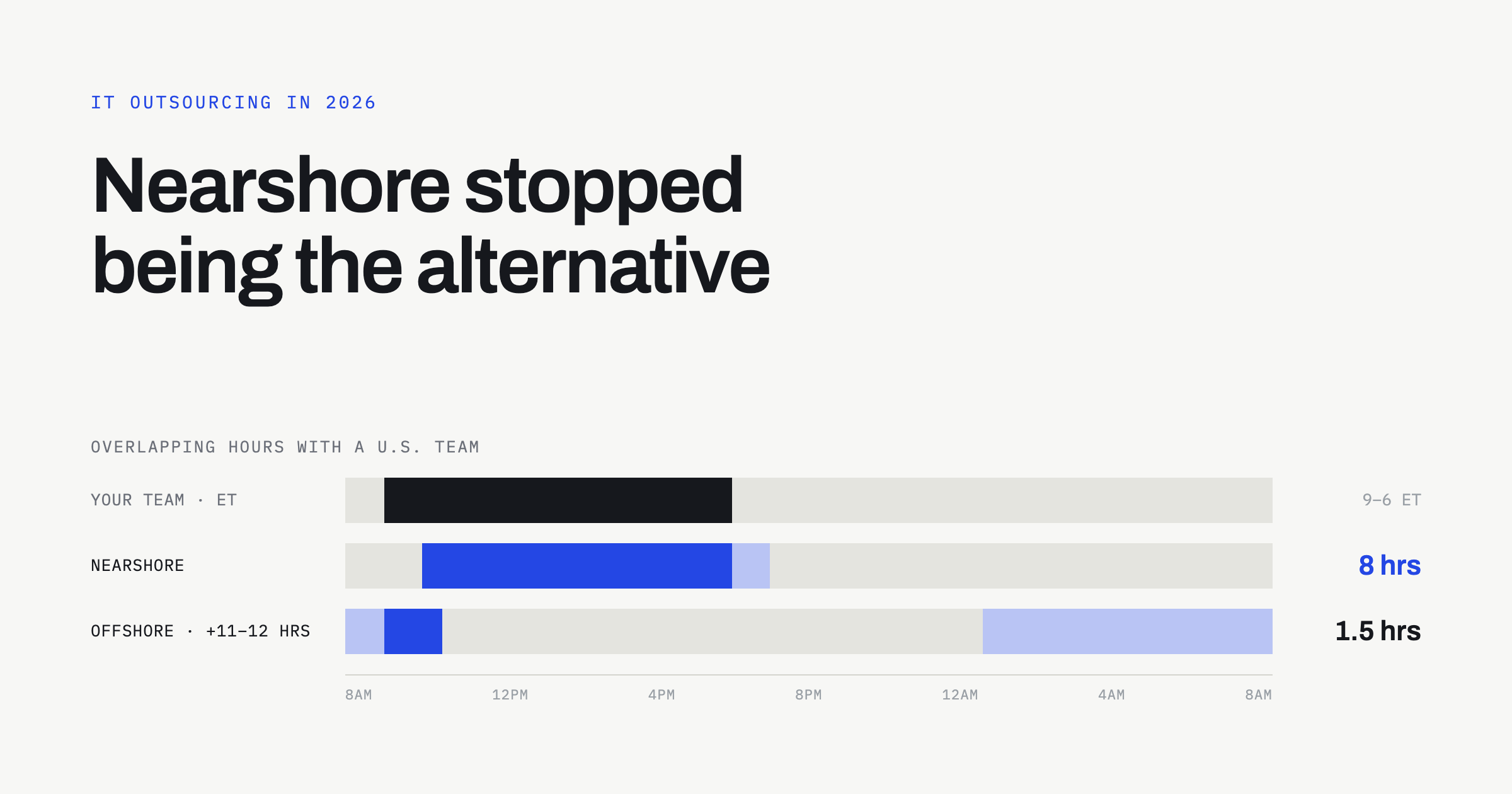
Here's a scenario we see constantly. A U.S. company hires an offshore team twelve hours away. The rate looks great on paper. Then a cloud migration breaks at 3 p.m. Eastern, and the engineer who understands the pipeline is asleep. A fix that should have taken forty minutes takes a day and a half, because every question has to travel through a message, wait overnight, and come back as another question.
For some work, that's fine. Data entry, well scoped maintenance, ticket queues with clear runbooks. None of that needs live conversation. Nobody serious argues otherwise.
But the work companies are outsourcing now is different. Deloitte found that 83% of executives are already using AI within their outsourced services. That means AI implementation, DevOps, platform engineering, security work touching production. It's iterative. It breaks at inconvenient hours. It gets better through daily conversation with your product team, not weekly status reports. You want that engineer in your standup, in your incident call, in the Slack thread while the problem is still fresh. Not reading a summary the next morning.
One more elephant in the room: AI coding tools keep absorbing the well-defined, self-contained work, and that was precisely what the cheapest offshore hour was built on. What's left, and what companies actually pay for now, is judgment-heavy, collaborative work that needs a senior engineer in the conversation. That raises the bar for every outsourcing model. Proximity just clears it more easily.
Latin America sits one or two time zones from most U.S. cities, so the working model changes from handoffs to actual teamwork. That's the argument everyone knows. What fewer people talk about is what the time zone does to the team itself, and that's where the numbers get uncomfortable.
The part nobody puts in the sales deck
When a team half a world away serves U.S. business hours, somebody pays for it in sleep. Not always with full night shifts; plenty of offshore engineers work their own daytime and stretch into two or three hours of late-evening overlap. But the more real-time collaboration you demand, the more of their night you're buying. And the cost of that shows up in places you can measure.
Start with the people. Working against the body's clock wears them down. At the industry's extreme, in around-the-clock call centers, staff burn out roughly 2.5 times faster than office workers on normal hours, and night shift workers across outsourcing report consistently more sleep and health problems. Engineering teams rarely live at that extreme, but they sit on the same slope. The engineer debugging your production incident at what is, for them, midnight, is not the engineer they'd be at 11 a.m.
Worn-down people quit, and the turnover numbers say so. Offshore IT services firms lose 15 to 30% of their people every year; at the BPO end of the industry, annual attrition has historically approached 50% and still runs between 30 and 40%. Even at the low end, do the math as a client. The engineer who understood your architecture in January may be gone before the year closes, and you pay, in ramp-up time and repeated mistakes, to rebuild knowledge you already paid to build once. Nearshore doesn't make turnover disappear; good engineers get recruited everywhere, Latin America included. What it removes is one specific, well-documented driver of it: nobody on the team is being asked to live against their own clock to match your calendar.
Then there's the problem the industry only recently started discussing openly: engineers quietly holding multiple full-time jobs at once. In 2022, Wipro, one of the world's largest IT services firms, fired 300 employees it found simultaneously on the payroll of direct competitors, and a Kotak Institutional Equities survey at the time found 65% of IT employees saying they or someone they knew was moonlighting remotely. To be fair, this is a remote-work problem before it's an offshore problem; it has happened in every geography, including the U.S. But distance and asynchrony are what make it easy to sustain. An engineer you mostly know through overnight messages and weekly check-ins can split their attention across two employers for months without anyone noticing. An engineer who's in your morning meetings, pairing on code live, and picking up the phone when production breaks has far fewer places to hide a second job. Overlap doubles as daily visibility, and you get it for free.
So is nearshore always the answer? No.
Let's be honest about the trade-offs, because glossing over them is how companies end up disappointed.
Nearshore rates run higher than the cheapest offshore options. If your work is genuinely self contained, clearly scoped, and measured on output alone, paying a premium for time zone overlap you'll never use is just waste. Teams farther away, or increasingly AI tooling itself, remain the right call for that kind of work, full stop.
What we see working best in 2026 is usually a hybrid. A nearshore layer handles everything communication heavy: architecture, product iteration, incident response, anything touching production. Offshore capacity adds scale for everything else. The question stopped being "who's cheapest per hour?" and became "how much back-and-forth does this work actually need every day?" If the answer is a lot, you want overlap. If the answer is almost none, you want the best rate. Answer that honestly and the geography mostly picks itself. That's what shopping for the best-fit hour looks like in practice.
One last thing, and it's the one that never shows up on a rate card. Call it the coordination tax: misread requirements, rework, meetings scheduled at 6 a.m., decisions delayed a day at a time. Add the human tax: burnout, turnover, and divided attention. Those two taxes together are what quietly eat the savings the cheapest hour promises. More than any single trend, that's why nearshoring to Latin America moved from "an alternative worth considering" to the starting assumption for U.S. technology teams.
Martinexsa USA connects U.S. technology teams with vetted engineers across Software Engineering, Digital & Web, Cloud & DevOps, and Data & AI, drawn from a talent network spanning 16 Latin American markets. If you're rethinking how your team gets built in 2026, book a call and we'll map out what a nearshore team could look like for you. ---
References
• Deloitte Global Outsourcing Survey 2024 (cost driver fell from 70% to 34%; 83% AI-powered outsourcing): deloitte.com/global/en/issues/work/global-outsourcing-survey.html
• BPO/HR industry statistics (higher sleep and health problems among night shift BPO workers; call center burnout 2.5x faster than office staff)
• India BPO attrition data (historically ~50%, currently 30-40%; IT services 15-30%)
• Wipro moonlighting terminations, Sept 2022 (TechCrunch / The Register coverage) and Kotak Institutional Equities moonlighting survey (65%)
• ManpowerGroup Talent Shortage Survey (74% of employers struggling to hire)
Topics
Software engineering expertise.
See the capabilities behind the engineers we present.
Explore Software Engineering