Team building
They Ask for AI Engineers. Sometimes They Need Data Engineers.
September 1, 2026· Martinexsa Engineering· 8 min read
A company says it needs an AI or machine learning engineer. The job description sounds right: build models, work with LLMs and move projects into production. But before recruiting starts, there is a more useful question: what will this person actually spend their first ninety days doing?
Sometimes the answer is data engineering: cleaning data, reconciling systems, building pipelines, fixing broken schemas and figuring out why last month's dataset does not match this month's. In other companies, the bottleneck is model deployment, retrieval, evaluation or the application layer. The point is not that Data Engineering should come first. It is that the work should be diagnosed before the role is named.
That is the hiring problem this article is about. Titles are imperfect proxies for the skills, ownership and technical layer a company actually needs. Name the requisition too early and the search can be accurate against the wrong role.
Why getting the title wrong is expensive
Data Engineering makes the mismatch concrete. Robert Half's 2026 Salary Guide puts the national starting midpoint for an AI/ML engineer at $170,750, compared with $156,250 for a data engineer, a difference of $14,500 or roughly 9%. The premium is noticeable, but it is not the expensive part of getting the requisition wrong.
If the mismatch eventually contributes to turnover, Gallup estimates the replacement cost for professionals in technical roles at roughly 80% of annual salary. On a $170,750 hire, that is approximately $136,600 before considering the disruption of reopening the search, interviewing again and rebuilding momentum.
A candidate can be qualified, the recruiter can execute well and the interview process can work exactly as designed, yet the hire can still fail because the requisition was built around the wrong technical layer.
What the three roles are built to do
Data Engineering, Machine Learning Engineering and Applied AI Engineering can share parts of the same stack, but they usually solve different technical problems and own different parts of the system.
| - | Data engineer | ML engineer | Applied AI engineer |
|---|---|---|---|
| Primary problem | Make data reliable, accessible and usable | Build predictive systems from data | Build applications using LLMs and generative AI models |
| First deliverable | Reliable, reproducible datasets in production | A production ML system that reliably trains, deploys or serves models | A production feature built around a foundation model that meets quality, latency and cost targets |
| Typical work | Pipelines, transformation, orchestration, data modeling and quality | Training, deployment, model serving, monitoring and retraining | RAG, retrieval, embeddings, agents, tool calling and evals |
| Owns | Data pipelines, warehouses, lakehouses and data contracts | Training pipelines, feature infrastructure, deployment and monitoring | Retrieval systems, AI application layer, agent workflows and LLM evaluation |
| 2026 starting midpoint | $156,250 | $170,750* | $170,750* |
*Robert Half publishes a single AI/ML Engineer benchmark rather than separate figures for Machine Learning and Applied AI Engineering.
That shared benchmark does not mean Machine Learning and Applied AI are the same job. Compensation data is still catching up with the way these roles are separating in practice. So we looked at the work companies actually describe when they hire for them.
Data Engineering stands apart. ML and Applied AI overlap.
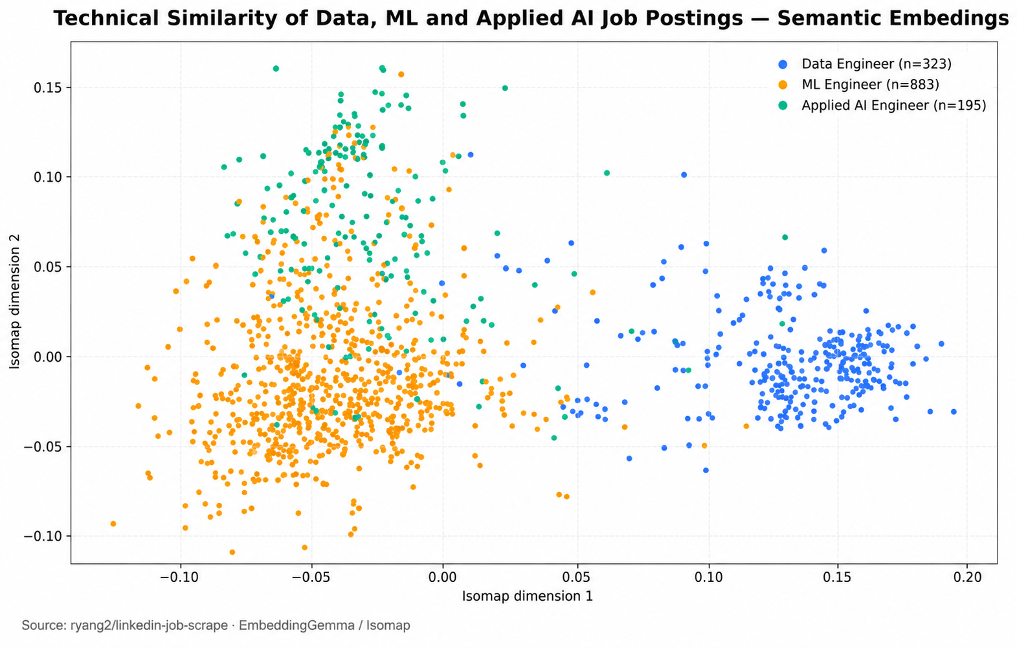
Our analysis covered 1,401 deduplicated U.S. job postings from 654 companies across Data Engineering, Machine Learning Engineering and Applied AI Engineering. An extraction model received the job description and isolated technical content; job titles were excluded from the representation and used only afterwards to assign the published role category. The semantic analysis represented the extracted technical content with embeddings and projected the resulting vectors to two dimensions with Isomap. Each point below is one posting. Points that appear closer together describe more similar technical work. The axes are projection coordinates, not business metrics.
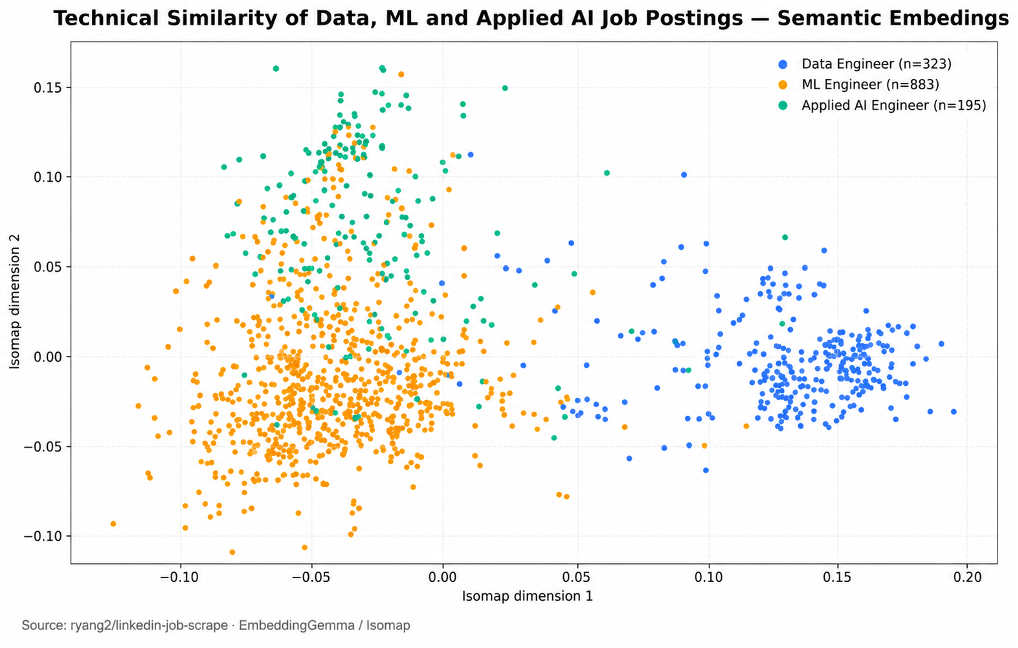
Figure 1. Semantic embeddings: 1,401 postings across 654 companies. Job titles are excluded from the technical representation and used only as labels.
The semantic view shows the clearest separation in Data Engineering. Its main concentration sits apart from the other two role families, while Machine Learning and Applied AI occupy neighboring regions with substantial overlap. Some of that overlap is expected: ML and Applied AI engineers often share Python, APIs, deployment infrastructure, evaluation practices and cloud technologies. Applied AI still forms a recognizable concentration of its own, consistent with its emphasis on LLMs, retrieval, agents and AI application development.
The chart does not show that Machine Learning and Applied AI are interchangeable, and it cannot determine whether an individual posting is mislabeled. A posting inside another role's region could be genuinely hybrid, reflect a different organizational boundary or carry a title that does not fully describe the work underneath it. The narrower conclusion is more useful: the published title is an incomplete description of the technical work, so hiring should begin with the work, ownership and skills the person will actually need.
What the analysis can and cannot tell us
Four caveats matter. First, the postings were scraped between February 2024 and August 2025, when Applied AI titles and responsibilities were evolving quickly. Second, the figure is a two dimensional projection of a much higher dimensional semantic space, so it should be read as a map of structure rather than a precise measurement of distance.
Third, the role groups are unequal in size, with substantially more Machine Learning postings than Applied AI postings. Fourth, the analysis depends on structured technical content extracted from job descriptions, so the extraction step can influence the resulting representation. The figure therefore supports a market level pattern, not a classification of any individual requisition.
Within those limits, the pattern is still useful: Data Engineering appears more distinct, while Machine Learning and Applied AI occupy closer and more overlapping regions of the technical landscape.
Diagnose the bottleneck, not the title
The chart shows why the title can be an imperfect proxy. To decide what to hire for, the next step is to diagnose the layer that is actually blocking progress. External research points in the same direction without identifying one universal bottleneck: Cloudera has highlighted data access and quality as common constraints on AI initiatives, while Deloitte has identified workforce skills as a major barrier to integrating AI into existing workflows.
Sometimes the problem is data readiness. Sometimes it is ML infrastructure. Sometimes it is Applied AI capability. AI engineering can also come first: a retrieval system over contracts or support tickets may not require a major warehouse project, and some mature teams are blocked primarily by evaluation, retrieval quality or productionizing LLM features.
The point is not to default to Data Engineering. The point is to identify the layer that is preventing progress, define the work and skills required there, and let the job title follow that diagnosis.
Four questions before you post the req
- Can you reproduce last Tuesday's dataset today, row for row? If nobody can reproduce it, or the result changes depending on who runs the query, the first problem is data reliability.
- How long does a new data point take to reach production? Time one record from capture to the moment it becomes queryable. Hours may be workable for many batch and decision support use cases; days can constrain near real time products before the hiring decision is even made.
- Do three systems agree on your most important metric? Pick one number from a board deck and ask three owners for the definition and current value. Material disagreement is a data contract problem. A model will inherit that disagreement rather than resolve it.
- Who owns the data the AI system would depend on? If nobody can name the owner of the critical tables, pipelines or sources, that is an ownership problem before it is an AI problem.
Fail several of these tests and the sequence likely starts at the data layer. Pass them and the diagnosis moves higher in the stack: model infrastructure, deployment, retrieval, evaluation or the application layer itself. The purpose is the same in either case: identify the work and skills required before deciding what title to put on the requisition.
Diagnose the layer before you name the role
The question is not whether your company needs AI talent. It probably does. The question is which layer is preventing you from shipping today and, therefore, what work the new hire actually needs to own.
If the first ninety days will be spent reconciling schemas, rebuilding pipelines and figuring out which definition of “customer” is correct, do not hire an AI engineer and ask them to become a data engineer. Hire the data engineer first. If the data foundation is solid and the real problem is predictive model training, deployment, serving or monitoring, the need is closer to ML Engineering. If the data and infrastructure are ready and the challenge is LLMs, retrieval, RAG, agents, evaluation or production generative AI features, the need is closer to Applied AI Engineering.
The title should come last. The diagnosis and the work should come first, because they determine the capabilities the role actually requires. But skills based hiring is only as good as the people defining and evaluating those capabilities. Without real domain experience, companies risk replacing title matching with keyword matching. Technical expertise is what turns a list of requirements into an accurate definition of the role and a credible assessment of the candidate.
It costs very little to change a requisition before the search starts. It costs considerably more to correct it after the wrong person has spent months doing the wrong job. Martinexsa USA helps companies define the technical work, skills and level of expertise they actually need before building the team around it. If you are about to open a Data, ML or Applied AI role, send us the requisition before you post it.
Sources and methodology
Sources: Robert Half, 2026 Salary Guide; Robert Half, 2026 Technology Salary Trends; Gallup, employee replacement cost estimates for technical professionals; Cloudera, Data Readiness Index, April 2026 (n=1,270); Deloitte, State of AI in the Enterprise (n=3,235); ryang2/linkedin-job-scrape, LinkedIn job postings dataset on Hugging Face.
*Job posting analysis: Martinexsa USA analysis of deduplicated U.S. job postings scraped from February 3, 2024 through August 29, 2025. The semantic analysis contains 1,401 postings across 654 companies: Data Engineering n=323, Machine Learning Engineering n=883 and Applied AI Engineering n=195. Titles were excluded from the technical representation and used only to assign the published role category. Semantic representation: Gemma 4 31B extracted four technical dimensions: day to day responsibilities, technical ownership, technical skills and technologies, using a fixed structured prompt. Each dimension was embedded independently with EmbeddingGemma, combined with equal base weighting and projected to two dimensions with Isomap. The figure summarizes broad market structure; it is not a classifier of individual postings.*
See how staff augmentation works.
How vetted professionals integrate into your existing team.
See How It Works