Team building
Résumés written by AI: how to know what an engineer can actually do before the interview
October 27, 2026· Martinexsa Delivery· 7 min read
Say a backend role goes up on a Monday. By Wednesday you have a few hundred applications, and the ten résumés that make it to your calendar read almost the same: the stack from your job post, a percentage on every bullet, and a line about building scalable systems. Then the interviews start, and by the second technical question you can tell which candidates have used the tools they listed.
If you hire software developers, you’ve probably had a week like that. The résumé was always a rough filter. Now it’s a weak one, because a candidate can rewrite it for every posting in a few minutes. Below: what changed, five signs that a résumé was written to match the job post, and what to check before an interview goes on your calendar.
What changed when candidates started writing résumés with AI
Volume went up first. LinkedIn told The New York Times in June 2025 that it was processing about 11,000 applications per minute, 45% more than a year earlier. Recruiters interviewed for that story pointed to generative AI as part of the reason.
Then the documents changed. In Gartner’s surveys of job candidates, 39% said they had used AI during the application process, and writing résumé text was the most common use, cited by 54% of them. Matching a résumé to a job post used to take effort. Today a model can copy the posting’s requirements into the document, so a perfect keyword match tells you more about the candidate’s tools than about their skills.
A smaller group goes further. In Greenhouse’s 2025 AI in Hiring Report, 65% of U.S. hiring managers said they had caught applicants using AI deceptively, 22% had found hidden instructions in résumés aimed at screening software, and 18% said applicants had shown up to interviews as deepfakes. In an earlier Greenhouse survey of 2,200 job seekers in the U.S., U.K. and Ireland, nearly one in three admitted to faking skills on their résumé, and 47% to embellishing their qualifications.
Using AI to polish a résumé is reasonable. Plenty of strong engineers do it to fix their grammar or to fit a page. The problem for you is narrower: the document no longer shows who can do the work, so every line on it is a claim you’ll need to check.
Five signs a résumé was written to match the job post
It repeats your job post back to you
The skills appear in the same order and with the same wording as your requirements. A real résumé reflects the projects someone worked on, and those rarely line up item by item with another company’s list. Put the posting and the résumé side by side. If every requirement shows up and nothing outside it does, ask where each skill was used.
The numbers have no baseline
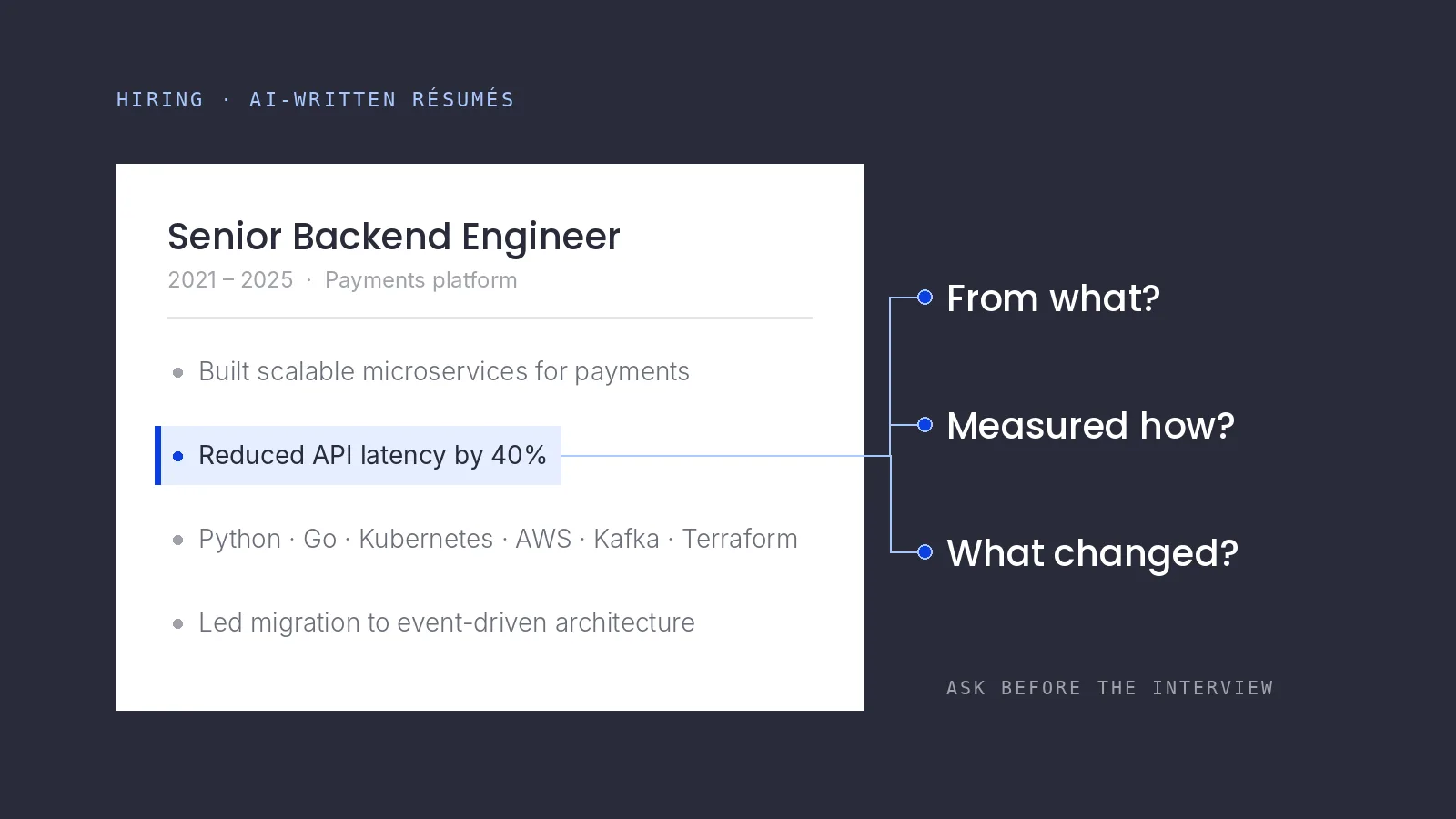
“Reduced API latency by 40%” sounds specific until you ask what it was before, how it was measured and what changed. A real number usually comes with a story about one bottleneck: a missing index or an N+1 query that ran on every page load. When every bullet ends in a round percentage and none of them has that story, treat the numbers as decoration.
The tool list is long and nothing is attached to it
Twenty technologies at the same level, none tied to a project. Engineers who have run a tool in production can tell you what it was bad at and when they would avoid it. Check whether each major tool on the list appears in at least one project description.
The scope doesn’t fit the timeline
“Led the migration to microservices” in an eight-month contract, or ownership of the architecture two years into a career. Either is possible, but the responsibility should match the time in the role, the size of the team and the person’s seniority. In the interview, ask what they decided and what someone else decided.
There’s text you can’t see
Some résumés include instructions in white or tiny type, written for the screening software and invisible to you. Paste the résumé into a plain-text editor or select everything in the PDF, and the hidden text appears. It tells you more about the candidate’s judgment than any bullet point.
One of these signs on its own proves little. When you see three or four together, the interview will have to do the work the résumé didn’t. Here is what to ask about each one:
Sign on the résumé | What to ask |
|---|---|
It mirrors your job post | “Where did you use this skill, and on what project?” |
Numbers without a baseline | “What was the starting number, and who measured it?” |
Long tool list with no projects | “What was this tool bad at, and when would you avoid it?” |
Scope bigger than the timeline | “What did you decide, and what did someone else decide?” |
Hidden text | Nothing to ask: paste it into a plain-text editor and look. |
What to check when you hire software developers
Research on hiring points in a clear direction. A 2022 re-analysis by Paul Sackett and colleagues in the Journal of Applied Psychology found that structured interviews had the highest average validity among the selection methods reviewed, with job knowledge tests close behind and work samples also predicting performance. A 2019 meta-analysis of more than 80 studies, led by Chad Van Iddekinge and published in Personnel Psychology, found very little relationship between years of experience before hire and later job performance.
Years and tool lists, the material a résumé is made of, are weak evidence. Stronger evidence comes from what a candidate can explain and show about the work your team needs done. Before the full interview loop, gather some of it:
Write down the two or three things the person has to deliver in the first months, such as maintaining payment integrations inside an existing architecture. Read résumés against that list instead of against the tool list.
Hold a 20-minute call with an engineer on your team about one project from the résumé, and go at least two follow-up questions deep. For example:
What broke the last time you worked on that integration, and how did you find it?
Which decision in that project would you change now?
Which part of the system did someone else own?
Take the 40% on your résumé. What was the starting number, and who measured it?
People who did the work answer with specifics, like the name of the service that failed or the trade-off they’d make differently. People repeating a résumé answer in general terms and get vaguer with each follow-up.
Ask for one piece of evidence tied to the role: code they can walk you through, a short review of a real pull request, or a small task close to the actual work. Keep it short. In the same Greenhouse job seeker survey, 28% admitted to using AI to generate fake work samples, so what matters is whether the candidate can explain the sample live.
Check that dates, titles and employers agree across the résumé, the LinkedIn profile and the references, and confirm on camera that the person you’re talking to is the person who applied. In Greenhouse’s 2025 report, 39% of U.S. hiring managers said they are holding more in-person interviews to verify authenticity, and Gartner predicts that by 2028 one in four candidate profiles worldwide will be fake.
Ask every candidate the same core questions and score them against the same criteria. That consistency is what makes an interview structured, and it’s the version the research supports.
How we handle this at Martinexsa USA
At Martinexsa USA, the résumé is where our evaluation starts, not where it ends. After we sign an NDA with you, AI helps us find candidates who match your role, stack and seniority. Every candidate on your shortlist then goes through a hands-on technical interview and a background check, and we assess technical depth, responsibility suited to the role, relevant industry experience, communication in English and professional verification. You can see how we evaluate talent.
Every profile we send comes with a full evaluation report, so you see where the candidate is strong and where they’re weaker for your role. You’ll know what to probe before the interview starts, instead of finding out at the second technical question.
If you have an engineering role open and you’d rather spend your interviews on people who can do the job, tell us what the role needs to deliver. After a 15-minute call, you receive up to three vetted profiles within two business days, at no cost and with no commitment.
Sources
eWeek, Job seekers flood LinkedIn with 11,000 applications a minute (reporting The New York Times)
Gartner, Survey shows just 26% of job applicants trust AI will fairly evaluate them (2025)
Greenhouse, 2025 AI in Hiring Report
UNLEASH, Greenhouse: 28% of candidates use AI to generate fake work samples (2025)
Sackett et al., Revisiting meta-analytic estimates of validity in personnel selection, Journal of Applied Psychology (2022)
Van Iddekinge et al., A meta-analysis of the criterion-related validity of prehire work experience, Personnel Psychology (2019)
Topics