Team building
AI coding tools changed what your team needs: who to add next
October 27, 2026· Martinexsa Delivery· 8 min read
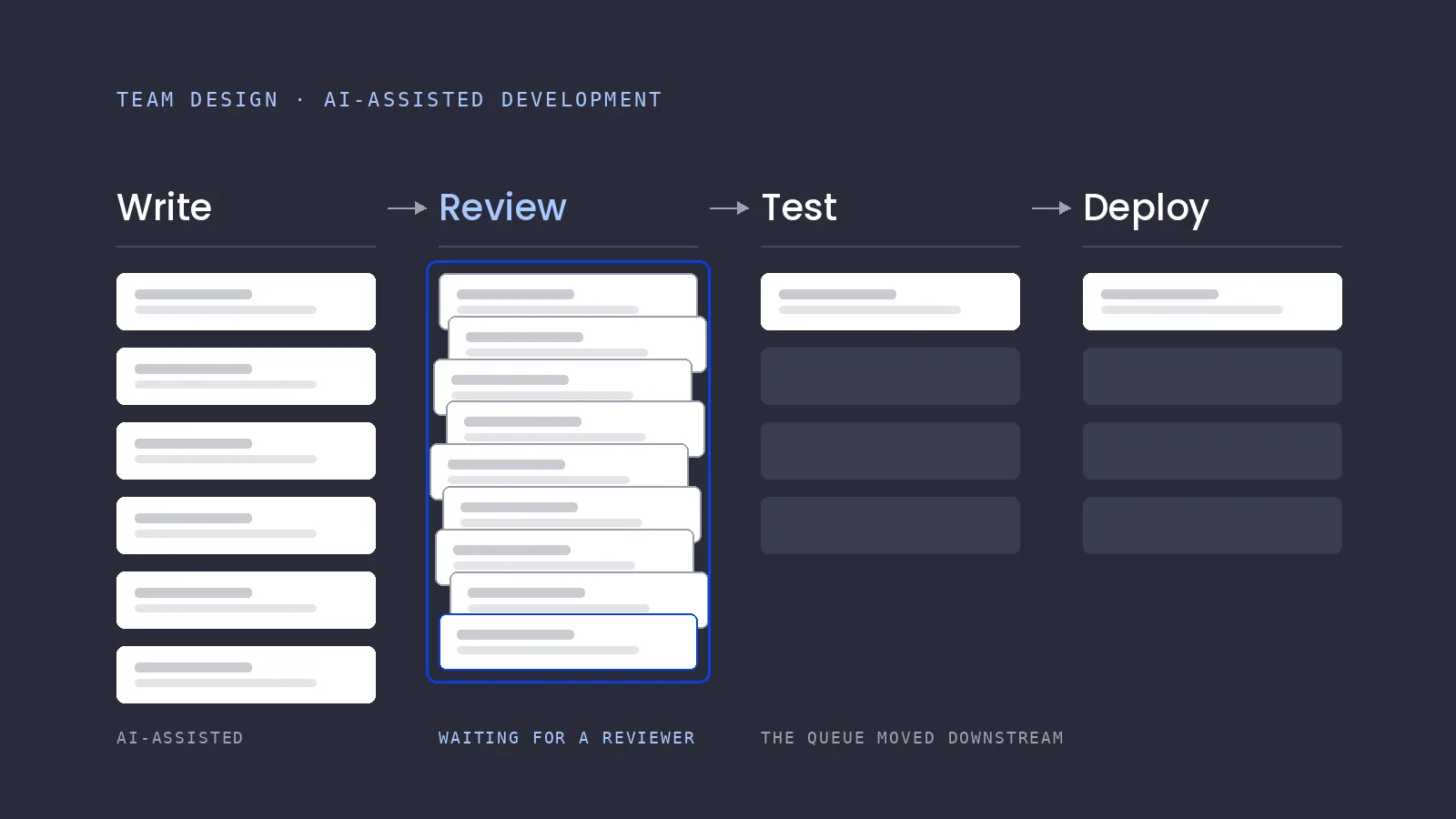
Say your team adopted an AI coding assistant last year. The number of pull requests went up within a few months. So did the time each one waits for review, the number of tests nobody wrote and the deploys that need someone to fix staging first. The headcount plan you wrote in January assumed you’d need more people writing code. What you need now looks different.
This article is for the VP or director who has to decide which profiles to add and which to stop hiring for. It covers what AI took over in day-to-day engineering, the roles that became bottlenecks, where you may need fewer people, and when IT staff augmentation makes more sense than opening a full-time position.
What AI coding tools took over, and what they didn’t
Adoption is close to universal. In Stack Overflow’s 2026 Developer Survey, with more than 30,000 respondents, over 80% of developers use AI tools, 66% use coding assistants or agents, and 73% of those use them every day.
The part AI absorbed is the first draft: boilerplate, scaffolding for tests, a function that follows a pattern already in the codebase. That’s work that used to fill a lot of a junior engineer’s week.
The part it didn’t absorb is judgment about the system. In the same 2026 survey, only 6.6% of developers said they trust AI for important decisions; nearly half trust it only when they can verify the work. A year earlier, Stack Overflow’s 2025 survey found that the top frustration, cited by 66%, was AI answers that are “almost right, but not quite,” and 45% said debugging AI-generated code takes them longer.
Measuring the gain is harder than it feels. In a small randomized study, METR had 16 experienced developers work on 246 real tasks in their own mature open-source projects. With early-2025 AI tools they took 19% longer, while believing they had been about 20% faster. In a February 2026 update, METR said newer tools now seem to speed developers up, but that its evidence is weak and the effect is hard to measure. The lesson for planning: don’t assume the gain your team feels is the gain you get. Security needs its own check: Veracode tested more than 100 language models on 80 coding tasks and found that the generated code introduced vulnerabilities in 45% of cases.
DORA’s research ties this together. Its 2025 report found that AI adoption goes with higher delivery throughput but also rising instability, and that the tools amplify whatever a team already does well or badly. Its 2026 report on the ROI of AI-assisted development adds a warning: expect a temporary productivity dip, driven partly by the “verification tax” of reviewing AI-generated code and by testing and approvals that must absorb more of it. If code moves faster than your review, testing and deployment can handle, the queue just moves downstream.
The roles that became bottlenecks
If you recognize the symptom on the left, the role on the right is usually the gap.
Symptom | Role to add |
|---|---|
Pull requests wait days for review | Senior engineer who owns reviews |
Test coverage isn’t growing with your pull requests | QA automation engineer |
Manual deploy steps, flaky pipelines | DevOps or platform engineer |
Code that handles login or user data goes out unreviewed | DevSecOps engineer |
AI features on your product roadmap | AI engineer |
Senior engineers who can review
More code per engineer means more code to review, and reviewing AI output takes someone who knows the system’s unwritten rules: why a table is never queried directly, which service can’t take extra load on Fridays. That knowledge sits with your senior engineers, and their review time is now the scarcest resource on many teams. Adding a senior engineer who can own reviews in one area often does more for throughput than adding two people who write code.
QA and test automation
“Almost right” code passes a quick read and fails in production. A QA automation engineer builds the test suite that catches it and decides what is worth testing. If your test coverage hasn’t grown at the same pace as your pull requests, this is usually the first gap to close.
DevOps, platform and reliability
Shipping more often only helps if releases are safe to roll back. Engineers who own CI/CD pipelines, observability and incident response keep that higher throughput from turning into the instability DORA measured. Signs you need one: manual steps in your deploys, flaky pipelines that people rerun until they pass, or incidents found by customers before your monitoring.
Security in the pipeline
Given Veracode’s results, someone has to own static analysis, dependency checks and the review of code that handles authentication or user input. On smaller teams this can be part of a DevOps role. On larger ones it’s a DevSecOps position of its own.
AI engineers, if your product is adding AI features
This is a different need from using coding assistants. An AI engineer integrates language models into your product and builds the evaluations that tell you whether those features work. If AI is on your product roadmap, plan for this role separately.
Sometimes the role a team asks for isn’t the one it needs. We compared 1,401 U.S. job postings on exactly that question in They Ask for AI Engineers. Sometimes They Need Data Engineers.
Where you may need fewer people
AI took over the most repetitive part of engineering work, so some hiring plans written before it no longer hold.
Roles that mainly add capacity on routine code
If a position exists mostly to produce boilerplate, standard screens or code that follows existing patterns, an engineer working with AI tools now covers much more of it. Before opening another role like that, check whether your real constraint is review, testing or deployment.
Junior engineers: fewer, not none
Entry-level hiring has dropped. In their August 2026 update, researchers at the Stanford Digital Economy Lab, using ADP payroll data, found that employment of workers aged 22 to 25 in the occupations most exposed to AI is about 19% below where it would be if it had kept pace with less-exposed occupations. The gap comes mainly from companies hiring fewer young people, not from layoffs, and the authors say they can’t yet confirm that AI is the cause.
Hiring fewer juniors can make sense for now. Hiring none is a different decision: the senior reviewers you depend on today were juniors a few years ago. Juniors who learn to test and review AI output become the reviewers you’ll need next. DORA’s 2026 report points the same way: it advises against cutting headcount and favors retraining the people you have.
How to build the team: in-house or with external engineers
The question to ask about each gap is how long it will last and how much of your product knowledge it requires.
Hire in-house when the role holds knowledge you want to keep for years, such as the architecture of your core product, or when the person will lead others. Those roles take time to fill and pay off over time.
Bring in external engineers when the need is defined but its length isn’t. A test suite that has to catch up with two years of feature work, a CI migration, a review backlog before a major release, or a skill you want to try before deciding on a full-time position. In those cases, waiting months for a hire costs more than the gap itself.
One rule applies either way: the final review of what goes into your main branch should stay with someone who knows the system. External engineers can write, test and review code, but your team decides what gets merged.
When IT staff augmentation makes sense
IT staff augmentation means adding engineers who work inside your team, with your tools and your processes, while your leads direct the work. It fits when most of these are true:
You can name the bottleneck. Pull requests wait days for review, nobody owns the test suite, or deploys depend on one person.
Someone on your team can give technical direction and act as a point of contact.
You can describe the work for the next few months, even if you don’t know what comes after.
You need the skill now and want to confirm the workload before opening a full-time position.
It fits poorly when no one on your side can set priorities or approve technical decisions, or when the work is so central that the knowledge has to stay inside the company long term. Even a senior engineer who leads architecture works best with a clear decision-maker on your team.
How Martinexsa USA works with teams in this situation
Martinexsa USA’s staff augmentation adds engineers to your team in software engineering, digital and web, cloud and DevOps, and data and AI. Your team directs the roadmap and the daily work; we handle selection, onboarding and follow-up after the engineer starts. Every profile we send comes with a full evaluation report, so you see where the candidate is strong and where they’re weaker for your role.
If work is piling up somewhere between code and production, tell us where. We start from the bottleneck and work back to the profile: after a 15-minute call, you receive up to three vetted profiles within two business days, each with a full evaluation report, at no cost and with no commitment.
Sources
Stack Overflow, 2026 Developer Survey results
Stack Overflow, 2025 Developer Survey: AI
Google DORA, 2025 State of AI-assisted Software Development
Google DORA, The ROI of AI-Assisted Software Development (2026)
InfoQ, New DORA report: strong engineering foundations drive AI return on investment (2026)
METR, Measuring the Impact of Early-2025 AI on Experienced Open-Source Developer Productivity
METR, We are changing our developer productivity experiment design (February 2026)
Veracode, GenAI Code Security Report
Stanford Digital Economy Lab, Canaries in the Coal Mine? (August 2026 update)
Topics
Related insights