Engineering
Hard to fill positions in tech: narrow the role first
November 24, 2026· Martinexsa Delivery· 5 min read
Hard to fill positions in tech usually have one of two problems: too few people in the market have the skill, or the role is defined in a way that almost nobody matches. Check the role first: it’s the one part of the search that’s entirely under your control.
Say a backend role has been open since the summer. Your recruiter has sent a dozen profiles, your team has interviewed four people, and none of them was a fit. The usual next step is to widen the search: more job boards, a higher salary band, maybe a second agency. Sometimes that’s the right call. Before you spend more, check whether the role you’re hiring for is the role you actually need.
What does the 2026 data say about hard to fill positions?
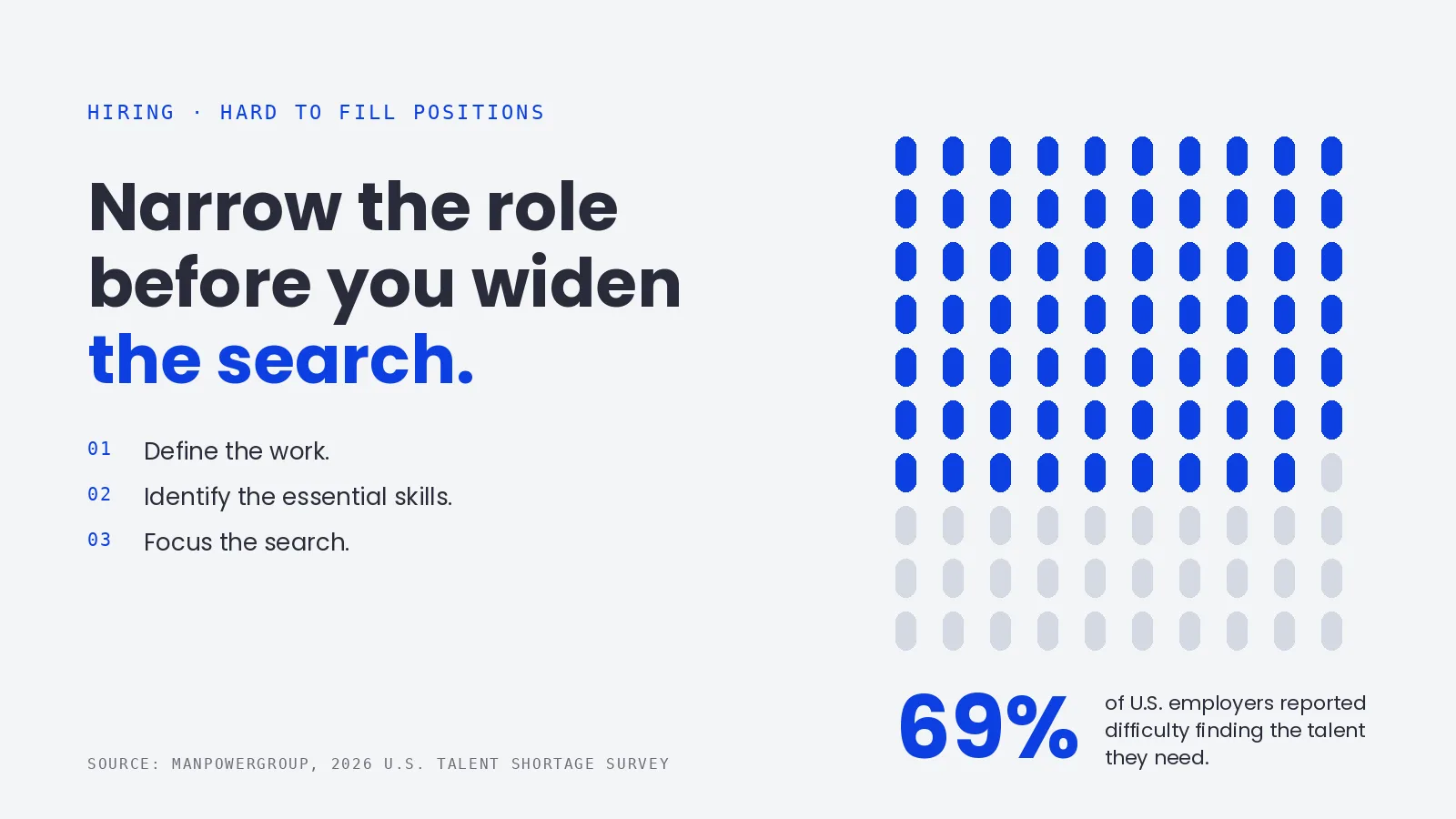
ManpowerGroup’s 2026 Talent Shortage Survey asked more than 6,000 U.S. employers about hiring in October 2025. 69% said they had difficulty finding the talent they need, slightly down from 71% the year before. The two sectors closest to software teams reported more trouble than average: 72% in Information and 72% in Professional, Scientific and Technical Services.
The same survey asked employers what they’re doing about it, and the answers lean in one direction. 27% are upskilling their current staff, 25% are expanding their talent pools and 24% are raising wages. Smaller groups are spending more on job ads (16%), adding temporary or contract workers (12%) or sourcing talent from other markets (9%). Only 10% are reducing or removing degree requirements, and 9% are reducing skills requirements.
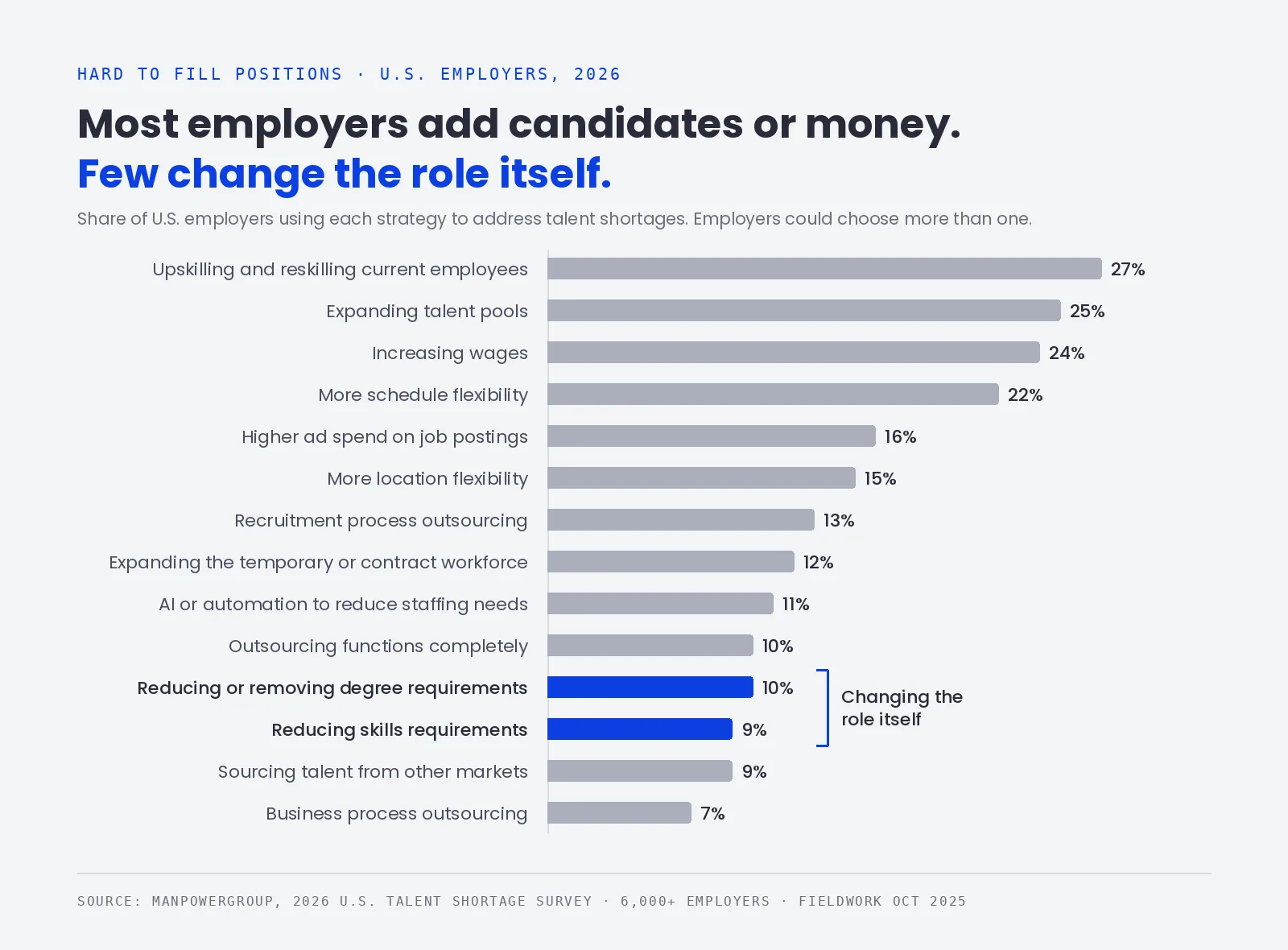
Most of those responses add candidates or money, and few go back to the job description. Requirements aren’t always the problem, but they’re the cheapest thing to check.
Is it a market problem or a role problem?
Before changing anything, look at how the search has gone so far. The pattern of rejections usually points to one side or the other.
It’s probably the market when:
The people who match the role turn down the offer over salary or location.
Your recruiter finds very few people with the core skill at all.
Peer companies have had the same role open for months.
It’s probably the role when:
Your interviewers disagree about what a good answer looks like.
Each candidate gets rejected for a different reason.
Nobody on the team can say what this person should deliver in their first three months.
The job post lists a long set of tools as required, with no indication of which ones matter most.
If most of what you see is in the second list, a bigger search will bring you more of the same mismatches.
How do you narrow a role before you widen the search?
Start with the work, then the title
Start with what the person has to deliver in the first three months, in one or two sentences. A line like “Senior Backend Engineer, 7+ years, Java, Kafka, Kubernetes” tells a recruiter which profile to look for. A line like “Maintain our payment integrations and own their test coverage” says what the person will do, and it gives recruiters and interviewers something to check candidates against. The second line is illustrative, but most teams can write their own in ten minutes.
Separate day-one skills from skills they can learn
Split the requirements into two lists. Day-one skills are the ones your team can’t teach in the first month, such as experience with the core language of your codebase or with the kind of system the person will own. Learnable skills are everything else: a second framework, your internal tools, a cloud service that works like one they already know.
Keep the first list short. Each item on it removes candidates, so each one should earn its place.
Give everyone in the process the same target
Once the short list exists, share it with everyone involved: the recruiter, the hiring manager and each interviewer. Ask every candidate the same core questions about the work and score their answers against the same criteria. That shared target makes it easier to pass on profiles that look strong on paper but don’t match the work, and to spot good candidates whose résumés don’t use the words in your job post. For what to verify beyond the résumé, see how to know what an engineer can actually do before the interview.
A role brief you can copy
Fill this in before the next search and send the same version to your recruiter and every interviewer:
Role: [title]
In the first three months, this person will: [one or two sentences about the work]
Day-one skills, kept short: [skills the team can’t teach in the first month]
Can learn on the job: [everything else]
Core interview questions, the same for every candidate: [questions about the work]
Who makes the final call: [name]
When does widening the search make sense?
If the role is clear and candidates are still scarce, then it’s time to widen. The options in the ManpowerGroup data fit different situations.
Upskilling an internal engineer works when someone on the team already has most of the day-one skills and you can give them time to learn the rest. It’s slower, but the knowledge stays with you.
Adding contract or augmented engineers through staff augmentation works when the deadline won’t wait for a full hiring cycle, or when you want to confirm the workload before opening a full-time position.
Sourcing from other markets works when the skill is scarce where you’ve been looking. For U.S. teams, the practical question is time zones: engineers who share most of your working day can join standups, reviews and incident calls like anyone else on the team.
How Martinexsa USA helps with hard to fill tech roles
At Martinexsa USA, we start from the same place this article does: what the role needs to deliver. We add engineers from Latin America to U.S. teams in software engineering, cloud and DevOps, data and AI, and cybersecurity, and they work your team’s hours.
For a defined role, we send up to three shortlisted profiles within two business days. Every profile comes with a written report on where the candidate is strong and where they’re weaker for your role.
We’re not the right fit if you need on-site work, a direct hire or security clearance.
Frequently asked questions
What is a hard to fill position?
A role that stays open well beyond your usual time to hire while you’re actively recruiting for it.
Does narrowing the role mean lowering the bar?
No. The day-one skills stay strict. Skills the team can teach in the first month stop being requirements, so fewer good candidates are filtered out before anyone talks to them.
How fast can an augmented engineer start?
With Martinexsa USA, shortlisted profiles arrive within two business days. Once you accept a candidate, onboarding takes one to two weeks.
If a role has stayed open longer than planned, tell us what it needs to deliver and we’ll send a shortlist.
Topics