Engineering
Staff augmentation services for tech teams: how it works
November 24, 2026· Martinexsa Delivery· 5 min read
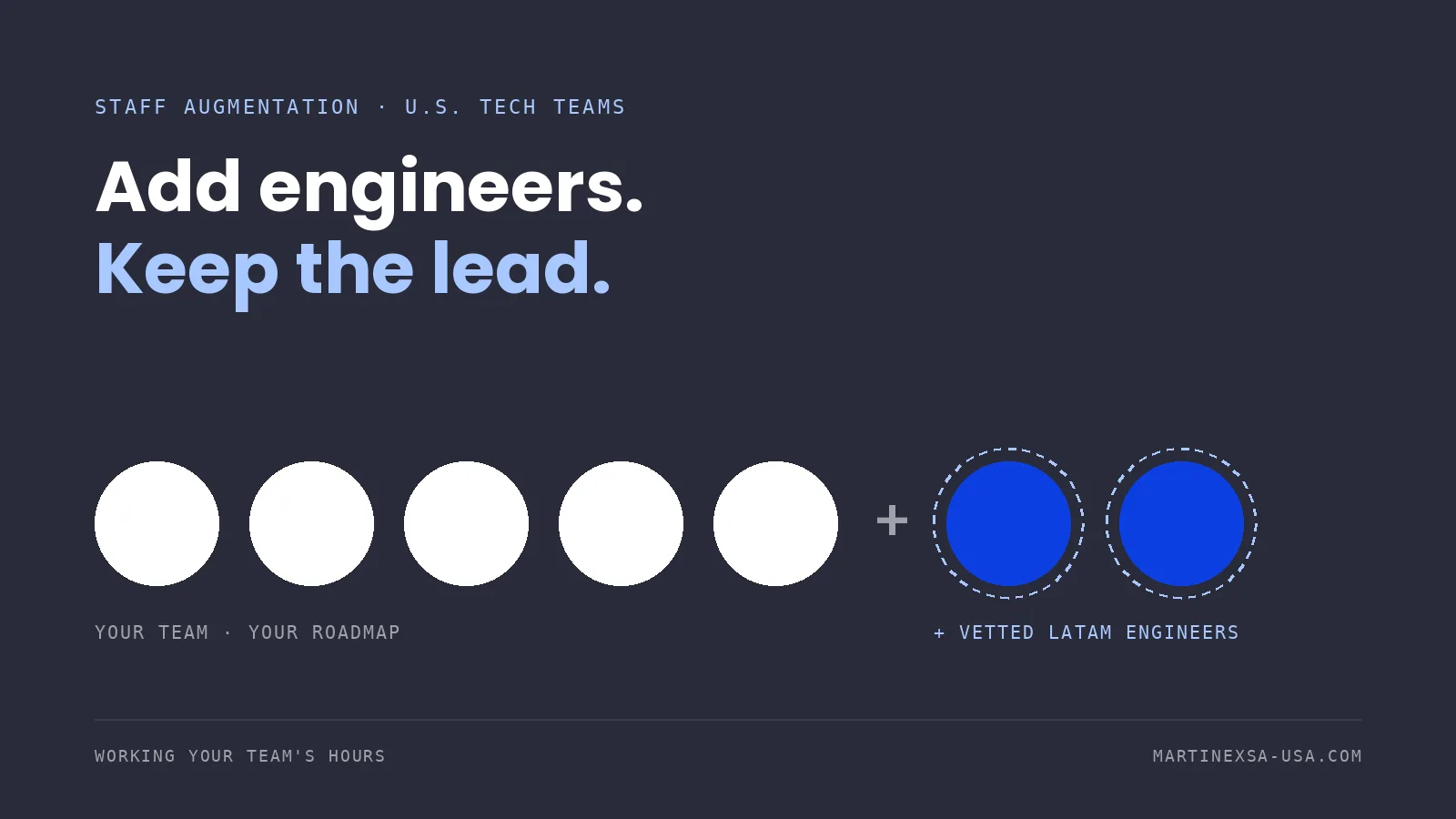
Staff augmentation services add external engineers to your existing team: they work inside your tools and processes, and your leads keep directing the work. The model fits when the work is clear and the gap is capacity or skills. A typical case: your roadmap needs two more backend engineers this quarter, and opening full-time positions would take longer than the work can wait.
What is staff augmentation?
Staff augmentation adds people to your team without hiring them as your own employees. In direct hiring, the person becomes your employee and the whole search runs through your team. In project-based outsourcing, you hand over a defined scope and the provider manages the people who deliver it. With staff augmentation, the scope and the management stay with you.
What do staff augmentation services include, and what stays with you?
Write down the split of responsibilities before any engagement starts.
At Martinexsa USA, the client keeps the roadmap and priorities, technical direction, day-to-day management, processes and tooling, and the final selection of who joins the team.
Martinexsa supports the talent side: sourcing and matching, candidate validation, interview coordination, onboarding and ongoing support after the professional starts.
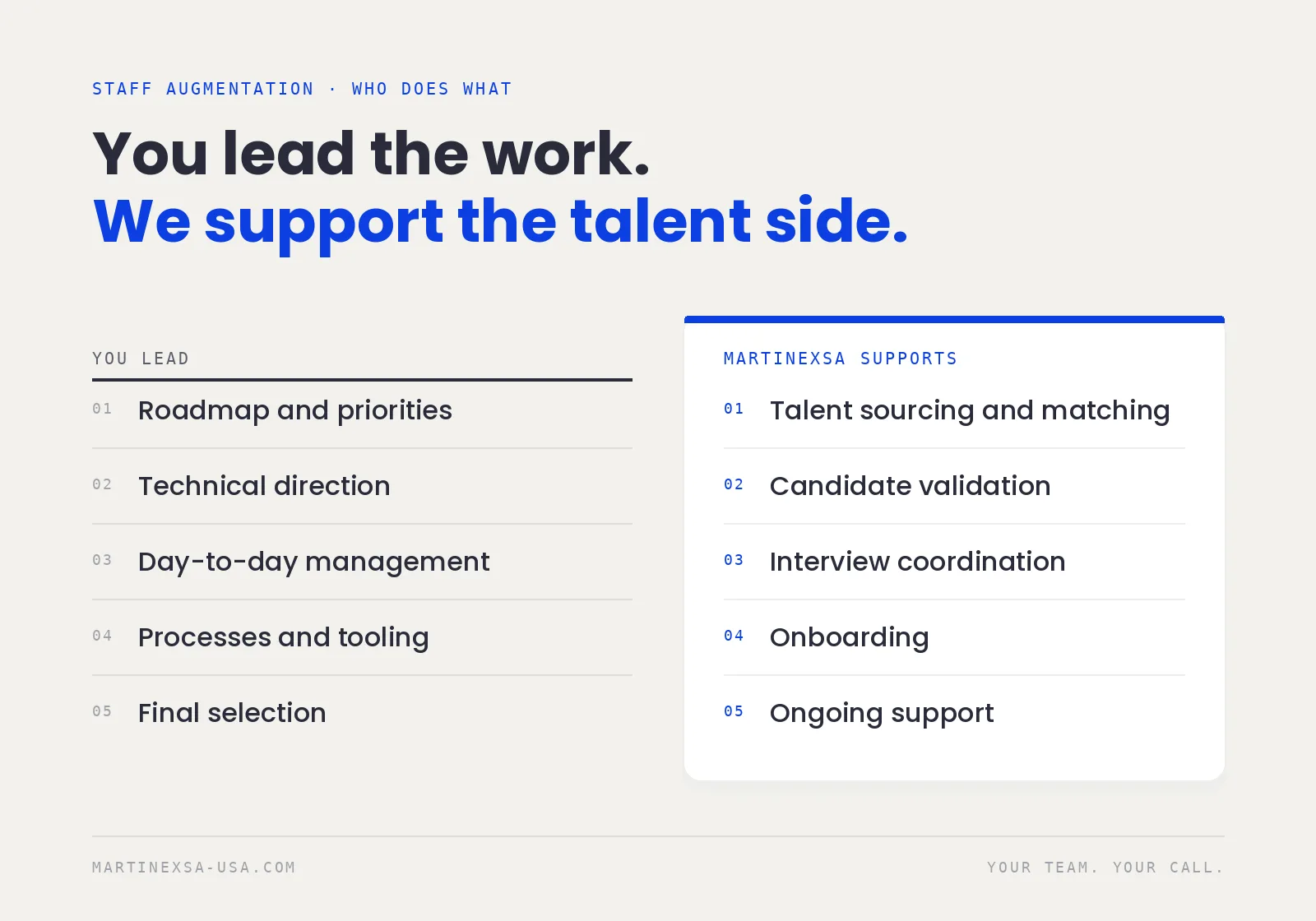
If a provider can’t give you this split in two lists, ask until it can. A task that isn’t on either list usually ends up with nobody.
When does staff augmentation fit a tech team?
The model works best when the work is clear and the gap is in capacity or skills. These are four situations where it fits:
A deadline your team can’t absorb. The roadmap is set, and you need more people for a defined period.
A skill your team doesn’t have yet. For example, a data engineer while you build your first pipelines. Related: why teams that ask for AI engineers sometimes need data engineers.
A long absence on a key team, such as parental leave or a sabbatical you need to cover.
Growth before full-time roles, when you want to confirm the workload before deciding on headcount.
When does another model fit better?
Staff augmentation needs someone on your side who can give technical direction. If nobody on the team can review the work or set priorities, an augmented engineer will spend much of their time waiting for answers.
It’s also a weaker fit when the need is a defined project with its own scope and timeline. In that case a project team, managed by the provider, may serve you better. Martinexsa USA offers both, and the right choice depends on who will manage the work.
What questions should you ask a staff augmentation company?
Whichever provider you talk to, these six questions tell you more than a pitch deck. The weak answers below are illustrative.
How do you evaluate candidates technically, and who runs the interview?
Strong answer: Names who runs it, someone who does that work, and what the candidate has to do hands-on.
Weak answer: “We have a thorough process,” with no detail on who or how.
What do I receive with each profile besides the résumé?
Strong answer: A written evaluation that includes the candidate’s weaknesses for your role.
Weak answer: A résumé and a summary that only lists strengths.
Where do your candidates come from?
Strong answer: Says which part comes from people they already know and which from a new search.
Weak answer: “A large database,” with no word on when they last spoke with the person.
Who manages the day-to-day work, and who handles everything else?
Strong answer: Two written lists: what your leads own and what the provider owns.
Weak answer: “We adapt to whatever you need.”
What happens after the start date, and who do I call?
Strong answer: A named contact and a fixed follow-up schedule with the engineer and with you.
Weak answer: “Reach out if anything comes up.”
Will the professional work during my team’s hours?
Strong answer: States the hours of overlap with your time zone, in writing.
Weak answer: “Flexible hours,” with no number.
A provider that answers these clearly, in writing, is easier to work with when something goes wrong.
How does Martinexsa USA deliver staff augmentation services?
These are our own answers to those questions:
Evaluation. Every candidate goes through three filters: AI matching, a recruiter and a technical evaluation with experts in the discipline. The background check comes afterward, and only for the candidate you choose.
What you receive. Up to three shortlisted profiles, each with a written report on where the candidate is strong and where they’re weaker for your role.
Where candidates come from. Searches start with talent we already know and expand to external sourcing when the role needs it. The full process is on our IT staff augmentation page.
Who manages what. Your leads direct the work. We handle recruiting, onboarding and follow-up.
After the start date. We follow up weekly with the engineer and every two weeks with you.
Working hours. The engineer works your team’s hours, so they join the same standups, code reviews and incident calls as the rest of your engineers.
We work in four disciplines: software engineering, cloud and DevOps, data and AI, and cybersecurity, with engineers from Latin America. Martinexsa USA is new in the U.S. market and is backed by a group with 40+ years in technology.
We’re not the right fit if you need on-site work, a direct hire or security clearance.
What should you settle before day one?
Settle these with your provider in writing before the engineer starts:
Overlap. The exact hours the engineer shares with your team each day, and which meetings fall inside them.
Holidays. The engineer’s local public holidays for the next quarter, added to your team calendar.
Equipment. Who provides the laptop and which security software it has to run.
Access. Which repositories, environments and data the engineer gets on day one, and who approves each.
Background check. What it covers, when it happens and who sees the result.
First two weeks. The first task and who reviews it.
Frequently asked questions
Is staff augmentation the same as outsourcing?
No. In project-based outsourcing the provider manages the people and the scope. In staff augmentation the engineers join your team and your leads manage the work.
What happens if an engineer isn’t the right fit?
At Martinexsa USA we find a replacement. Hours already worked are billed as usual.
How fast can an augmented engineer start?
With Martinexsa USA, shortlisted profiles arrive within two business days. Once you accept a candidate, onboarding takes one to two weeks.
Start with one role
If you have a role in mind, the simplest way to see how the model works is to try it with that role.
Topics